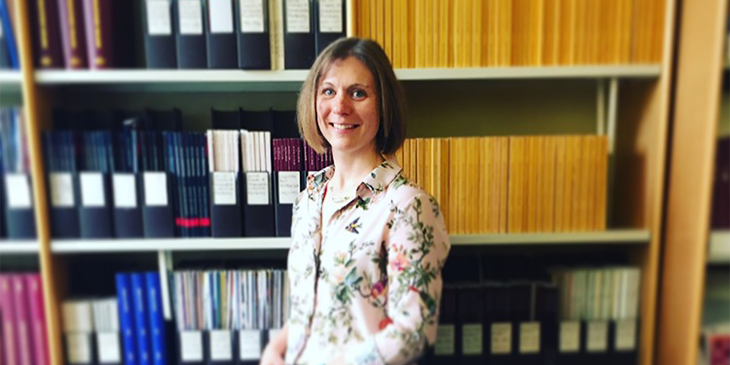
Tabitha Gould
Tabitha leads on the writing and development of the Cambridge Mathematics Framework. She contributes to research and thought leadership in mathematics education, including the design of innovative professional learning journeys and resources from Cambridge Mathematics.
As a former mathematics teacher, Tabitha contributed to mathematics learning and enrichment activities for both teachers and students for many years. She also led her school’s involvement in various classroom-based research projects. Leaving the classroom in 2014, Tabitha contributed to the development of Underground Mathematics, where she designed rich resources and professional learning opportunities to support the teaching and learning of A level mathematics. During this time, she was also a member of the NRICH secondary mathematics team, involved in designing classroom tasks, mapping tasks to the English National Curriculum, and delivering enrichment activities for students and professional learning for practitioners. More recently, Tabitha contributed to the redesign of the Mathematics Mastery Secondary curriculum and resources as a part of Ark Curriculum Plus.
Academic qualifications:
MA; PGCE (Secondary Mathematics)
Professional memberships:
2018 – present International Society for Design and Development in Education (ISDDE): Fellow
Publications:
Li, X., Gould, T., Zaki, R. (2024). The impact of artificial intelligence on learners and teachers: A mathematics education perspective. In S. Papadakis & M. Kalogiannakis (Eds.), Education, development and intervention: Vol. 23. Integrated science (pp. 133–148). Springer.
Jameson, E., Gould T., & Rycroft-Smith, L. (2022). Designing for teacher reflection and engagement with research on connection mathematical ideas. In C. Fernandez, S. Llinares, A. Gutierrez & N. Planas (Eds.), Proceedings of the 45th Conference of the International Group for the Psychology of Mathematics Education (Vol. 4, p. 240). PME.
Rycroft-Smith, L. & Gould, T. (2022). “And then you just arrive at zero again”: Ways that representations of the number line in board games may support or impede a sense of number. In R. Marks (Ed.), Proceedings of the British Society for Research into Learning Mathematics, 42(1). BSRLM.
Baker, A., Brown, P., Gilbey, J., Gould, T., & Kimber, E. (2017). Underground Mathematics: Supporting teachers to develop students’ mathematical thinking and problem solving. IMA and CETL-MSOR 2017: Mathematics Education beyond 16: Pathways and Transitions.
Steel, T., Thomas, C., Dawes, M., & Watson, S. (2015). GCSE mathematics for AQA/Edexcel/OCR Higher/Foundation: Problem-solving book. Cambridge University Press.