View related sites

  • About us
  • FAQ
  • Newsletter
  • Contact us
  • Facebook
  • Twitter
  • LinkedIn

Cambridge Mathematics

  • Home
  • Manifesto
  • Mathematical salad
  • Espresso
  • Research
  • Events
  • Media
  • About us
  • FAQ
  • Newsletter
  • Contact us
  • print

Mathematical and computational thinking

  • Cambridge Mathematics
  • Espresso
  • Mathematical and computational thinking
  • Espresso
  • 27: Spatial Skills
  • 26: EAL students in mathematics classrooms
  • 25: Introduction to fractions
  • 24: Mathematical and computational thinking
  • 23: Concepts of the mean
  • View all Espressos

20 November 2019

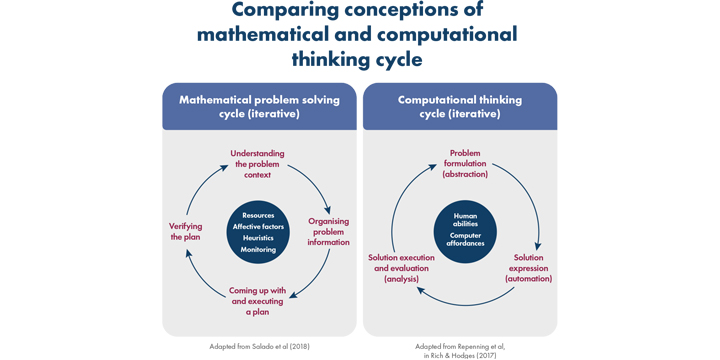
What are mathematical thinking and computational thinking and what is the relationship between them?

  • Mathematical thinking (MT) and computational thinking (CT) are both types of abstract problem solving approaches which may have some overlap
  • MT and CT are similar in that they can both be improved upon by practice with reflection; they may support one another
  • CT is evolving in comparison with the longer-established MT
  • Using both MT and CT might support students in feeling comfortable with trial and error, ambiguity and flexibility. Both support students becoming independent learners and can be learned at any age
  • CT is more constrained by hardware and real-world constraints than MT; CT may apply more broadly than MT
  • Processes common to both may include decomposition, algorithm design and modelling thinking
  • MT can be practised in the context of computational tools and CT in the context of mathematics
View Espresso

Useful links

  • Home
  • Manifesto
  • Mathematical salad
  • Espresso
  • Research
  • Events
  • Media
  • About us
  • FAQ
  • Newsletter
  • Contact us

About Cambridge Mathematics

Cambridge Mathematics is committed to championing and securing a world class mathematics education for all students from 3 – 19 years old, applicable to both national and international contexts and based on evidence from research and practice.

  • Cambridge Mathematics

View Related Sites

  • University of Cambridge
  • Cambridge University Press
  • Faculty of Mathematics
  • Faculty of Education
  • Cambridge Assessment

© UCLES 2019

  • Sitemap
  • Accessibility
  • Data Protection
  • Use of Cookies
  • Statement on Modern Slavery
  • Terms and Conditions
Back to top
We use cookies. By clicking any link on this page you are giving your consent for us to set cookies
Accept