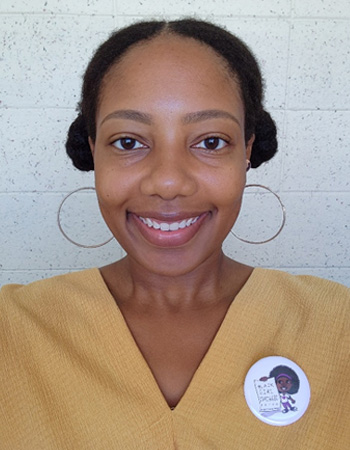
Dr Keisha Cook is a mathematician and professor at Clemson University, who uses maths modeling, statistics, data and computer programs to solve real-world mysteries. Her research helps scientists understand movement of tiny particles, living cells, disease spread, biophysics, bioengineering and even forest infestations. She is a passionate advocate for making maths accessible, creative and relevant.
Beyond her research and teaching, Dr Cook is dedicated to outreach, mentorship and expanding opportunities in STEM for women, underrepresented students and K–12 students in mathematics and STEM. She serves in leadership roles with the Association for Women in Mathematics and the Society for Mathematical Biology and contributes to the Mathematical Association of America’s Committee on the Participation of Women. Through outreach programmes and STEM initiatives, she helps young people see that maths is creative, useful and for everyone, including them!
1. What’s your earliest memory of doing mathematics?
My earliest memory of doing math was when I was about 8 to 10 years old. I spent my summers and afternoons teaching my younger sister math using a child-sized whiteboard and chalkboard playset. I created lessons and taught her everything I could. She eventually skipped kindergarten because she was already ahead of the curriculum. From then on, I continued helping her with her math homework.
I also have fond memories of my third-grade math teacher, Ms. Bodie. She was a Black woman, and her classroom was always exciting, welcoming, and filled with fun activities. I was especially competitive during our timed math-drill worksheets and probably won about 95% of them against the rest of the class.
2. How has mathematics education changed in the time you have been involved in it?
Mathematics has changed significantly as technology has become a larger part of education. I remember using specific calculators assigned to each grade level, but we did not use technology in our math classes. Everything was handwritten, and solving problems, especially more difficult ones, often took time because we had to search through textbooks, encyclopedias, and library resources. Google did not become an option for help or references until I reached college. As a result, we primarily learned from our teachers, with limited opportunities to access or share additional resources. By the time I entered college and graduate school, online resources had expanded and knowledge was being shared more widely. Learning became faster and more collaborative, while teaching increasingly encouraged students to explore their individual interests beyond what was covered in the classroom.
3. Tell me about a time in your career when something totally flabbergasted you.
I once worked with a master’s student who completed each task extremely quickly, mastered the material, and moved on to new challenges before our weekly meetings. I had to keep up with him, and he ended up teaching me about topics outside my usual research area that were highly applicable to the questions our mathematics group explores. It was exciting to have him lead each meeting and teach me. Eventually, I stopped preparing in advance because he was always several steps ahead!
4. Do you practise mathematics differently in company?
When I am around people outside the field of mathematics, I often hear them complain about how much they dislike math or how it has always been their least favorite subject. I used to avoid these conversations, but in recent years, I have started sharing a few facts about how mathematics is used in the real world to give them something to consider. I also explain that foundational mathematics is really about problem-solving, not just equations, numbers, and letters combined without purpose. When people hear about simple, relatable applications, their expressions often shift from frustration to curiosity.
5. Do you think a brilliant maths teacher is born or made?
I believe brilliant math teachers are made, but they are also born with qualities that help them succeed. These qualities include curiosity, perseverance, patience, commitment to long-term projects, empathy, and creativity. An exceptional math teacher meets students where they are, identifies gaps in their understanding, and helps them approach challenging questions with confidence. Rather than forcing knowledge on students, great teachers encourage them to explore their interests and make the most of their individual educational journeys. They also share their skills through mentorship, helping the next generation learn from both their mistakes and their successes.
6. What’s the most fun a mathematician can have?
The most fun a mathematician can have is watching students accomplish their goals. Whether they are solving a difficult problem, submitting a paper, succeeding in a class, giving their first major presentation, or getting their code to work, I feel a deep sense of fulfillment and vicarious pride when I know my guidance has helped someone succeed. I also enjoy seeing new research projects emerge from unexpected academic conversations. Sometimes, two seemingly unrelated projects turn out to have meaningful connections, leading us to develop an innovative method, model, piece of code, or new understanding of a topic.
7. Do you have a favourite maths joke?
I have a lot of plants at home, so naturally, this is my favorite math joke:
Why do plants hate math so much?
It gives them square roots!
Join the conversation: You can tweet us @CambridgeMaths or comment below.