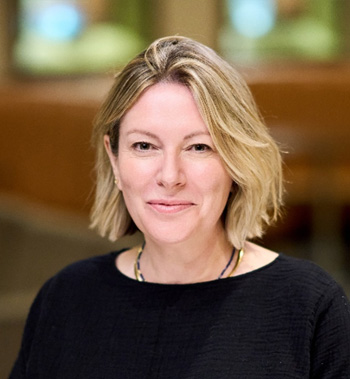
Rebecca is a Maths Education Support Lead at Mathematics in Education and Industry (MEI), working in the Further Education and Adult Learning strand. She trained as a primary teacher and worked as both a teacher and Special Educational Needs Coordinator in mainstream and special education before moving to the Further Education (FE) sector to work with resit maths students. She is particularly interested in understanding why some people find mathematics more challenging to learn, and in developing practical strategies to support those learners in the classroom.
1. What’s your earliest memory of doing mathematics?
When I was in nursery school, maybe about 3 or 4 years old, I remember being given Cuisenaire rods. I was allowed to take them home to play with, which felt like a very special treat. I liked using them to make different numbers in different ways and baffling my mum, who couldn’t see how different coloured rods could equal ten. With hindsight, I suspect she may have been humouring me. But I felt very proud of myself!
I also have very fond memories of working through School Mathematics Project (SMP) cards in primary school. The cards were stored in a box, and you would take one, complete it, mark it yourself and then take the next card. I remember the feeling of autonomy I had over my learning. I also remember very clearly that there were certain cards that would allow you to do some fun things. The most coveted one was the card that allowed you to pick a friend and disappear off with the trundle wheel to measure the playground. Looking back, I have no idea how this worked from a teacher’s perspective. I assume they checked in at some point to monitor our progress, but I have no recollection of that. I would love to know more about managing the logistics of this – if anybody reading can shed some light on it, I would be very interested. I have a saved search on eBay for SMP cards; hopefully one day I will track some down!
2. How has mathematics education changed in the time you have been involved in it?
I started my BEd in 1992, not that long after the days of SMP. The first time I was let loose to ‘teach’ maths as a student, I was given a small group of infant children I had never met before, some cubes, and told to let them explore numbers in the corridor. I had no idea what that meant and spent most of the session hoping nobody would walk past and ask what we were doing. I didn’t have any of the knowledge or skills required to make that meaningful for them or me.
Gradually, I learnt to plan slightly more effective learning experiences but in truth I felt very much at sea. I was hugely grateful when the National Numeracy Strategy (NNS) came along, giving me structure, stronger subject knowledge and a coherent pedagogy. This was a time when local authorities still had teams of subject specialists who provided training and there was a wealth of NNS material available in every classroom to support with planning, vocabulary, extension and support tasks.
It wasn’t entirely a golden era; I cringe a bit when I think of some of the differentiated tasks I provided and how rigidly I stuck to a scheme of work that was guided by what day of what week it was. But I learnt so much in those years, and it has shaped my career ever since.
Fast forwarding to the present day, I believe we are in a good place in terms of the ethos behind maths education in the UK. The core Teaching for Mastery belief that all children and young people can be successful at maths is a fundamental part of my own philosophy. I am extremely proud to work at MEI, as part of a Department for Education-funded project, on a programme that supports teachers’ development and creates space for professionals in this sector to collaborate and reflect.
3. Tell me about a time in your career when something totally flabbergasted you.
After I had my own children and a bit of a break from teaching, I decided to change tack a bit and went to work in a FE college with maths resit students. I thought they would mainly be a few marks away from a Grade 4 and would just need a bit of a refresher to push them over the line. The reality was quite different and maybe flabbergasted isn’t quite the right word, but seeing so many young people with such fundamental gaps in their mathematical understanding was certainly unexpected.
Of course, when I worked in primary schools, I knew that some children left Year 6 not being secure in their understanding. Looking back, I suspect I assumed that they would make progress and catch up eventually. Or at least, end up at a level where they would have been able to pass the Standard Assessment Tests, even if it was a year or so later. But for some, the attainment gap that exists when they start school widens throughout primary and continues to grow during secondary education. The reality of this is evident in resit classrooms.
Despite this (or more likely because of it!) I was quickly hooked by FE maths. I was reminded of all the reasons I wanted to be a teacher in the first place. Everybody deserves the chance to build a genuine, meaningful understanding of mathematics, as well as the opportunity to achieve an important gateway qualification such as GCSE maths.
4. Do you practise mathematics differently in company?
It depends on what the maths is and who the company is! I do GCSE-level maths all day, every day. So, amongst friends and family who don’t, I can split bills or help with homework with my head held high. In fact, I try to do it quickly to show off!
But I work with proper, actual mathematicians. With them, I’m a mixture of intimidated and starstruck, and if there was a situation where I had to practise maths in their company, I would be tempted to set off the fire alarm.
However, when I’m by myself and want to clear my head, I find maths, mainly exam papers, a very relaxing thing to do.
5. Do you think a brilliant maths teacher is born or made?
A bit of both, in so much as some people find maths more intuitive than others, and equally some people are more natural teachers.
Maths is both a compulsory subject until 16 (19 for those who are working towards a Level 2 qualification) and a popular A Level choice. It’s a subject that some adults must return to, if needed, to fulfil their ambition to retrain, say as a nurse or teacher.
So there needs to be brilliant maths teachers for all those brilliant students who deserve the absolute best, from the 2-year-olds in early years education to the A* A Level students – and all the students in between. I believe there is room for anybody who wants to be part of that.
What is truly incredible in the maths education community is how committed teachers are to helping each other. I completed Teacher Subject Specialism training, but it would not have been possible for me to successfully move from primary to FE if I hadn’t had such excellent support from the teachers I approached when I needed guidance or advice. Maths teachers really are the best cheerleaders for their subject.
6. What’s the most fun a mathematician can have?
I don’t know, you’d probably have to ask an actual mathematician! I consider myself very much a maths teacher, rather than a mathematician. So, I would say the most fun I have is when I’m experimenting with different ways of representing a concept. If that involves something concrete, then even better!
7. Do you have a favourite maths joke?
Why was it tragic when the parallel lines fell in love online?
Because they could never meet.
Join the conversation: You can tweet us @CambridgeMaths or comment below.