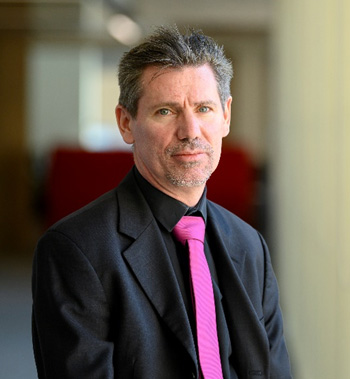
Steven is a Maths Subject Advisor with the UK examinations board Cambridge OCR. He mainly focuses on A Level Maths but supports teachers across all Cambridge OCR maths qualifications and is always available to support colleagues with the application of maths across the curriculum.
Steven regularly publishes exam question focussed blogs and co-authors the weekly #OCRMathspuzzle.
The views and opinions expressed in this interview are Steven’s and do not necessarily represent the views or positions of his employer.
1. What’s your earliest memory of doing mathematics?
I remember struggling with memorising times tables in primary school, and I didn’t enjoy the emphasis on recall and speed. It was only at secondary school that I started to enjoy the subject, partly because my maths teacher saw himself as a younger version of Johnny Ball, but mainly because the focus switched to problem solving and justifying solutions.
2. How has mathematics education changed in the time you have been involved in it?
The introduction of Core Maths is the major change while I have been involved in education. This is a new post-16 opportunity for those students that do not want to take A level Maths. Whilst students are still doing calculations, the emphasis is on interpreting the results in context and considering the limitations of any conclusions that may be drawn from those results.
The move from a spiral curriculum to a mastery approach is another big change in curriculum approach. But in terms of school curriculum content, the maths students study in school has not changed very much. When I left secondary school in the late 80s, calculators were replacing four-figure tables, and we had started programming using ‘BASIC’. When I returned to education at the end of the millennium, I was surprised that the maths curriculum had not embraced more technology or the way mathematics is applied in the modern workplace. There is a lot of talk about a digital curriculum, but the focus seems to be around what might be lost when moving from paper to screen rather than what could be gained.
Assessment styles seem to have gone full circle. I sat a linear O Level Maths at school whilst some of my friends sat the CSE (where the top grade 1 was officially equivalent to an O Level C grade pass). When I started teaching, students were sitting modular GCSE exams, at either Higher, Intermediate or Foundation Tier. We are now back to the linear approach, but tiering means that the available range of exam outcomes are still predetermined long before sitting down in the exam hall.
3. Tell me about a time in your career when something totally flabbergasted you.
I think the thing that totally flabbergasted me was at the start of my teacher training when I realised that maths is fun. At school and on my engineering degree, maths was just the easier bit of my studies. It was only during my PGCE, through the discussions at university and in my school placements, where I discovered that maths was more than just a collection of useful techniques. I came to the late discovery that finding the solution to one problem just opens the door to a whole new set of questions to think about, for no other reason than to satisfy personal curiosity.
4. Do you practise mathematics differently in company?
At work I will often type solutions using a maths package because it is easier to share solutions when discussing ideas online, but nothing beats talking through a problem and sharing scribbled solutions around the table in a conference session.
5. Do you think a brilliant maths teacher is born or made?
Some people take naturally to teaching, being able to communicate knowledge and radiate enthusiasm for their subject. But brilliant mathematics teachers are developed over time through deliberate, iterative improvements. They refine their practice by learning from their students, working with colleagues, and engaging with subject experts. Like successive approximations in numerical analysis, each iteration brings them closer to best practice, whilst always recognising there will be things that could still be improved.
6. What’s the most fun a mathematician can have?
I don’t claim to be a mathematician, but the best thing about being a maths teacher is that student 'Aha!' moment when a concept clicks and they realise they can now solve questions on a topic that they had previously struggled with.
7. Do you have a favourite maths joke?
Why was the maths book so sad? Because it had so many problems.
(It’s just such a ‘dad’ joke.).
Join the conversation: You can tweet us @CambridgeMaths or comment below.